I want to talk about skunk cabbage.
This sounds like the kind of sentence that usually precedes a digression, an apology, or a footnote explaining that skunk cabbage is a metaphor for something else. It is not. I literally want to talk about skunk cabbage. Specifically, the skunk cabbage that grew in the woods behind my childhood house in Finksburg, Maryland, and nowhere else in the world that I have ever been.
This is strange, because I have been to a lot of places. My brother and I hiked the entire Appalachian Trail together. Two thousand miles of ridgelines, valleys, shelters, rhododendron tunnels, bog bridges, alpine meadows, and wet forests. If skunk cabbage were a normal plant, we would have seen it again. If it were even a slightly common plant, it would have shown up at least once. It never did.
Which means that for my brain, skunk cabbage is not a plant. It is a location.
The plant that taught me what resistance smells like
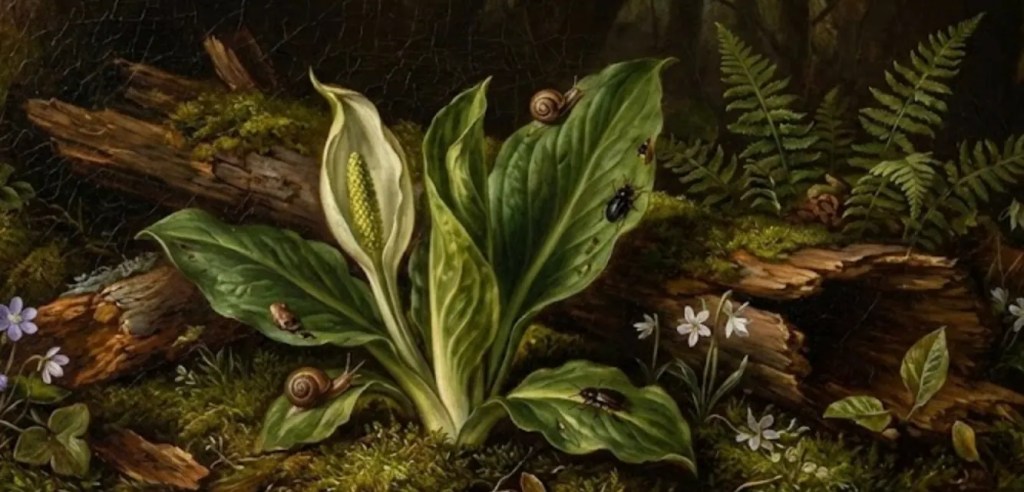
If you have never seen skunk cabbage in the wild, here is the important part. It does not look like a plant that belongs here.
It looks like something that crash landed.
In early spring it comes up as a purple hood sticking out of black mud, like a prop from a low budget science fiction movie. Later it turns into enormous, glossy green leaves that feel less like vegetation and more like a failed attempt at biological armor. If you step on it, it releases a smell that your brain immediately classifies as a warning. Not rotten. Not floral. Just wrong.
As kids, we did not know any of this intellectually. We knew it tactically.
The wetland behind our house was small. Not a swamp you would mark on a map. Just a low, muddy area fed by groundwater that stayed wet even in summer. You could not walk through it unless you cleared a path, and clearing a path meant knocking down skunk cabbage. There was no stepping delicately around it. It grew in dense, hostile clusters. Progress required violence.
So we learned that skunk cabbage was tough, territorial, and smelled like punishment.
This gave it personality.
Why this thing existed only behind our house
Finksburg is not wilderness. It is rural in the sense that there are trees and lawns and people who own riding mowers. Most kids I knew did not have wetlands behind their houses. They had woods that were dry enough to run through without thinking.
Our woods were different. They squelched. They sucked at your boots. They required trail maintenance.
This matters, because skunk cabbage does not grow in all wetlands. It grows in very specific ones. Groundwater fed, wooded, permanently mucky, stable over decades. The kind of place that never quite dries out and never quite freezes solid. These places are rare, and they are often small. According to ecological surveys, skunk cabbage colonies persist for decades or longer because their underground structures are massive and slow growing, essentially anchoring them to a specific hydrological niche.
As a child, you do not experience this as niche ecology. You experience it as ownership.
This was our plant. Our smell. Our monster.
An exhaustive field study of everywhere it was not
One of the quiet shocks of hiking the Appalachian Trail was discovering how generic most forests are.
This is not an insult. Forests are wonderful. But after a few hundred miles, you start to notice how often the same patterns repeat. Oak hickory slopes. Fern covered understories. Mud that looks like other mud.
And there was never skunk cabbage.
Not in Pennsylvania. Not in Vermont. Not in the Smokies. Not even in the cold seepage areas where, on paper, it could have existed. Every time we crossed a wet area, some part of my brain expected it. Like waiting to see an old friend in a crowd. It never happened.
This is how a childhood detail turns into a symbol. Not because it is profound, but because it refuses to generalize.
Why nostalgia works better when it refuses to generalize
Nostalgia usually works by abstraction. You remember summer. You remember bikes. You remember the feeling of being bored in a way that felt infinite.
Skunk cabbage does the opposite. It refuses abstraction.
You cannot remember skunk cabbage without remembering that exact patch of woods. The angle of the trees. The way the mud swallowed sticks. The fort we half built and abandoned. The path we cleared and recleared because plants do not respect childhood infrastructure.
It is not a memory you can export.
There is no skunk cabbage in my adult life, and that is the point. It anchors a version of me that cannot be recreated by visiting similar places. The plant is too specific. The wetland is too small. The conditions too exact.
What childhood wonder looks like in retrospect
I think part of what we mean by childhood wonder is not that the world was bigger, but that it was more uneven.
Certain things mattered enormously because they were rare and local and demanded interaction. You could not just observe skunk cabbage. You had to deal with it. It pushed back. It smelled. It forced decisions.
As an adult, I see skunk cabbage described as a thermogenic wetland plant with ancient evolutionary origins, a keystone species in certain seepage ecosystems. This is all true. It is also irrelevant to why it matters to me.
What matters is that it only existed there.
That the world once had corners that were not interchangeable.
That somewhere behind a house in Maryland, a weird plant grew in a weird patch of mud, and my brain decided, very early on, that this was what reality looked like up close.
 Jack Maguire