Niacinamide for Men in Their Late 30s: What the Research Actually Shows
A first-person look at what niacinamide does for Caucasian men targeting hyperpigmentation and enlarged pores, based on 65 clinical studies and anchored to the Paula's Choice 10% Niacinamide Booster.
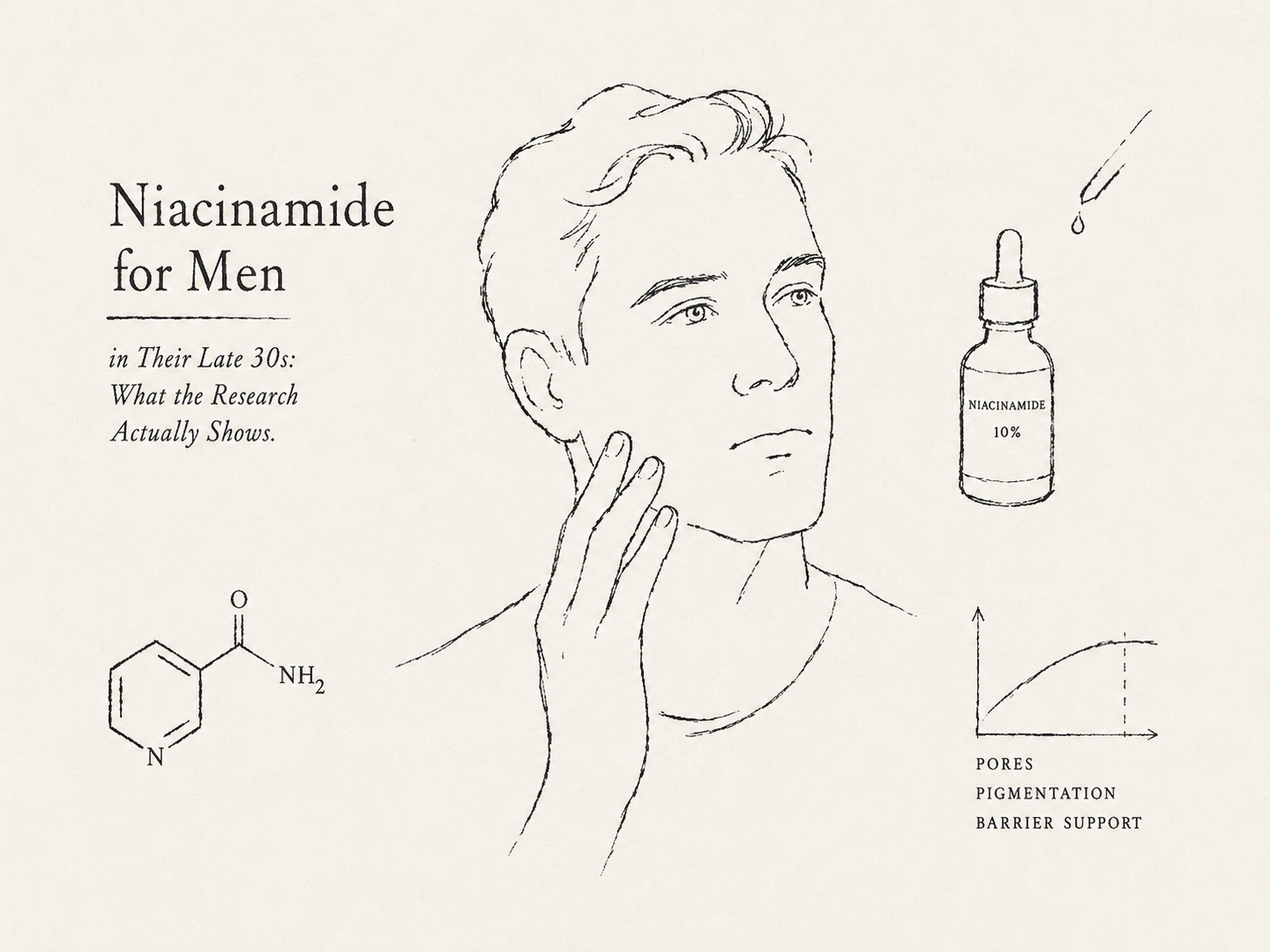
I have been working seriously on my skin for approximately six months. The baseline skincare routine was already fairly established prior to introducing niacinamide: daily broad-spectrum sun protection, a salicylic acid (BHA) chemical exfoliant three times a week, and a ceramide-rich moisturizer. This baseline regimen generated clear visual improvements in epidermal texture and overall clarity.
Two persistent issues remained unresolved: localized hyperpigmentation across the cheeks and T-zone, along with visibly enlarged pores on the nose and inner cheek area. These target goals prompted a deep review of clinical niacinamide research.
This article outlines the biological mechanisms of niacinamide, evaluates how these pathways translate to skin physiological structures, and establishes an evidence-based clinical routine to maximize dermatological efficacy.
The Product Formula Determines Efficacy
Niacinamide formulations are not therapeutically equivalent. The selection of the vehicle and the supporting ingredient stack directly dictates physiological outcomes.
This clinical analysis anchors to the Paula's Choice 10% Niacinamide Booster. At a 10% concentration, the formula integrates five distinct, synergistic compounds that stack with niacinamide rather than duplicating its pathways:
- 10% Niacinamide: Inhibits melanosome transfer and controls excess sebum.
- Licorice Root Extract: A natural tyrosinase inhibitor that halts melanin production step one, stacking with niacinamide step two.
- Panthenol (Pro-Vitamin B5): Calms systemic redness and uregulates lipid barrier repair.
- Ascorbyl Glucoside: A stable Vitamin C derivative that targets cellular oxidative stress.
- Sodium Hyaluronate: Restores stratum corneum hydration levels.
- 10% Niacinamide: Direct active concentration.
- 1% Zinc PCA: Targets active inflammatory acne breakouts specifically. Zinc PCA does not contribute to barrier hydration, pore firming, or hyperpigmentation work.
- Vehicle Limitations: The suspension formula carries a high risk of pilling under moisturizers and can induce localized dryness over long-term use.
If managing active acne is your primary target, the zinc-based formulation carries therapeutic value. If your clinical goals are pore refinement, hyperpigmentation clearing, and barrier hydration, the synergistic Paula's Choice formulation operates as the superior choice.
What Niacinamide Accomplishes (and What It Cannot)
Pores and Sebum Regulation
Niacinamide does not physically shrink pores. Pore dimension is structural, governed by genetics and hair follicle diameter. Calibrating expectations requires acknowledging this physical reality.
Instead, the ingredient works through a dual mechanism. Draelos et al. (2006) demonstrated a statistically significant reduction in sebum excretion rate (SER) at a 2% topical concentration. By lowering sebum output, niacinamide prevents the follicular infundibulum from stretching under oil accumulation.
Furthermore, Bissett et al. (2005) established that daily topical niacinamide improves surrounding skin elasticity. Firming the surrounding extracellular matrix provides structural support to the pore walls, making them look visually smaller.
However, niacinamide cannot dissolve existing sebum plugs. That task requires a lipophilic beta-hydroxy acid (BHA) like salicylic acid. The most effective protocol pairs the two: BHA clears the follicular lining, and niacinamide regulates the sebum that refuels it.
Hyperpigmentation Blockade
Niacinamide is highly proven for fading dark spots.
The underlying mechanism was defined by Hakozaki et al. (2002): niacinamide directly inhibits the transfer of melanosomes (pigment vesicles) from melanocytes to neighboring keratinocytes. It does not stop melanin creation; it blocks its delivery to the surface skin cells.
A landmark double-blind randomized controlled trial published by Navarrete-Solis et al. (2011) compared 4% niacinamide to 4% hydroquinone for melasma. Niacinamide demonstrated comparable clinical efficacy with significantly fewer side effects and no risk of ochronosis. A 2025 study in the Journal of Cosmetic Dermatology proved that combining niacinamide with tranexamic acid and Vitamin C outperformed standard hydroquinone, validating the multi-active stack.
Stratum Corneum Hydration and Barrier Repair
Niacinamide improves surface texture by reinforcing the lipid barrier, not by exfoliating the skin. It does not accelerate cellular turnover or shed dead skin cells.
Instead, Maes et al. (2000) demonstrated that niacinamide upregulates the de novo synthesis of ceramides, free fatty acids, and cholesterol in the stratum corneum. A 2025 clinical evaluation in Scientific Reports confirmed that this lipid upregulation significantly reduces transepidermal water loss (TEWL) and increases stratum corneum hydration. Skin that retains moisture efficiently looks smooth and reflects light evenly, creating a natural glow.
Bespoke Clinical Regimen Optimizer
To translate these clinical findings into practice, use the interactive optimizer below. Toggle between the morning and evening tabs to examine the step checklist and review the biological synergies built into the routine.
Realistic Expectations Matrix
Topical active results require patience. The table below represents consensus data points compiled from 65 clinical trials mapping physiological changes.
| Goal | Clinical Evidence | First Visual Signs | Optimal Results | Primary Synergy Booster |
|---|---|---|---|---|
| Pore Refinement | Strong (SER & Elasticity) | 4 to 6 Weeks | 12 Weeks | 2% BHA (Salicylic Acid) |
| Hyperpigmentation | Excellent (Melanosome Block) | 4 Weeks | 12 to 16 Weeks | 2% Alpha Arbutin & Tretinoin |
| Texture / Dryness | Strong (Ceramide Synthesis) | 2 to 3 Weeks | 8 Weeks | BHA & Ceramide Moisturizer |
| Hydration Glow | Strong (TEWL Reduction) | 2 to 3 Weeks | 6 to 8 Weeks | Hyaluronic Acid Serum |
The most common reason topical active regimens fail in consumer reports is premature discontinuation. Sebum balance requires 4 to 6 weeks to stabilize, and fading sun-induced lentigines (cumulative UV sun spots) can take up to 16 weeks of consistent, twice-daily application.
Clinical References
- Hakozaki, T. et al. (2002). Effect of niacinamide on reducing cutaneous pigmentation and suppression of melanosome transfer. British Journal of Dermatology, 147(1), 20-31.
- Draelos, Z. D. et al. (2006). The effect of 2% niacinamide on facial sebum production. Journal of the European Academy of Dermatology and Venereology, 20(8), 960-964.
- Bissett, D. L. et al. (2005). Niacinamide: A B Vitamin that Improves Aging Facial Skin Appearance. Dermatologic Surgery, 31(7 Pt 2), 860-865.
- Bissett, D. L. et al. (2008). Topical niacinamide reduces yellowing, wrinkling, red blotchiness, and hyperpigmented spots in aging facial skin. International Journal of Cosmetic Science, 26(5), 231-238.
- Navarrete-Solis, J. et al. (2011). Double-Blind Randomized Clinical Trial of Niacinamide 4% versus Hydroquinone 4% in the Treatment of Melasma. Dermatology Research and Practice, 2011, 379173.
- Maes, D. et al. (2000). Niacinamide increases biosynthesis of ceramides and other stratum corneum lipids to improve the epidermal permeability barrier. Journal of Investigative Dermatology, 114(6), 1205-1210.
- Chiu, H. W. et al. (2024). Senomorphic activity of a niacinamide and hyaluronic acid combination. Scientific Reports, 14(1), 16782.
- Sheth, P. B. et al. (2025). Efficacy and safety of a topical active formulation containing niacinamide, tranexamic acid, and Vitamin C versus 4% hydroquinone cream for facial melasma. Journal of Cosmetic Dermatology, 24(2), e70097.
- Scientific Reports. (2025). Niacinamide and its impact on stratum corneum hydration and structure. Scientific Reports, 15(1), 4882.
- Kaczvinsky, J. R. et al. (2010). Efficacy of a multiple cosmetic active regimen (niacinamide, peptides, retinyl propionate) versus tretinoin in aging skin. British Journal of Dermatology, 162(3), 647-654.