Transformative AI Is Coming Within Twenty Years: The Jane Street Panel as Five Prediction Markets
All four panelists agree: transformative AI is coming within twenty years [01:06:23]. They split on whether in-lab recursive self-improvement triggers a rapid takeoff before physical compute scaling runs out of steam around 2028–2030 [27:19].
In the Jane Street panel Is the AI Singularity Coming? | Jane Street AI Panel (published November 11, 2026), moderator Ron Minsky brings four AI forecasters together to revisit a debate Jane Street hosted 15 years ago, on whether an AI intelligence explosion (“foom”) will occur [00:10]:
Daniel Kokotajlo, Executive Director of the AI Futures Project, lead author of AI 2027 and AI 2040 Plan A [02:36]
Ryan Greenblatt, AI safety researcher at METR and former Chief Scientist at Redwood Research [02:09]
Jaime Sevilla, Founder of Epoch AI [01:37]
Ege Erdil, Researcher at Google DeepMind, co-founder of Mechanize, and former modeler at Epoch AI [01:55]
The five markets at a glance
Market 1: Full AI R&D automation
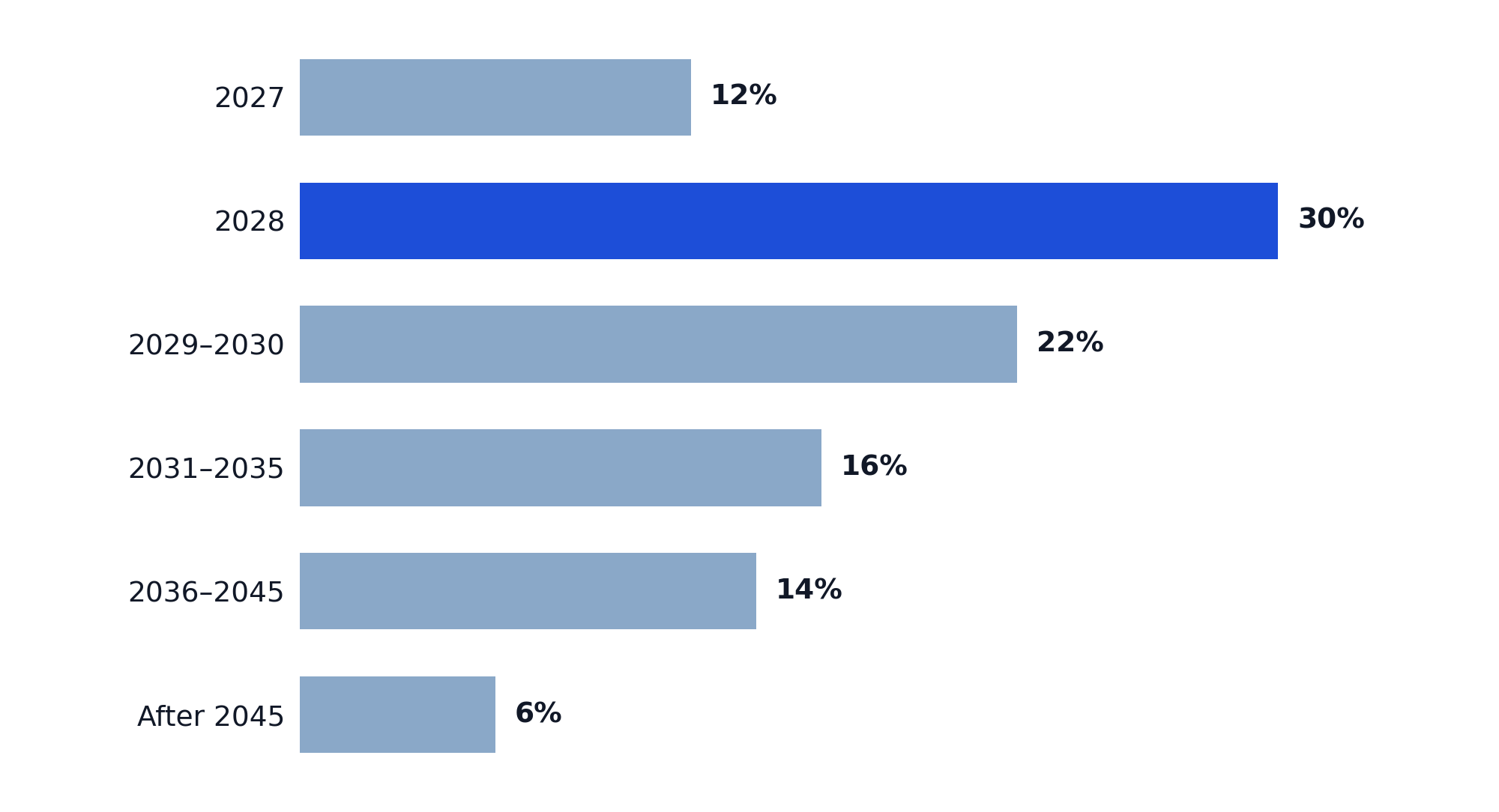
2027: Early takeoff tail · 2028: Kokotajlo median window · 2029 - 2030: 5-year trend extrapolation · 2031 - 2035: Post-compute-slowdown grind · 2036 - 2045: Requires broad economy loop · After 2045: Deep structural bottlenecks
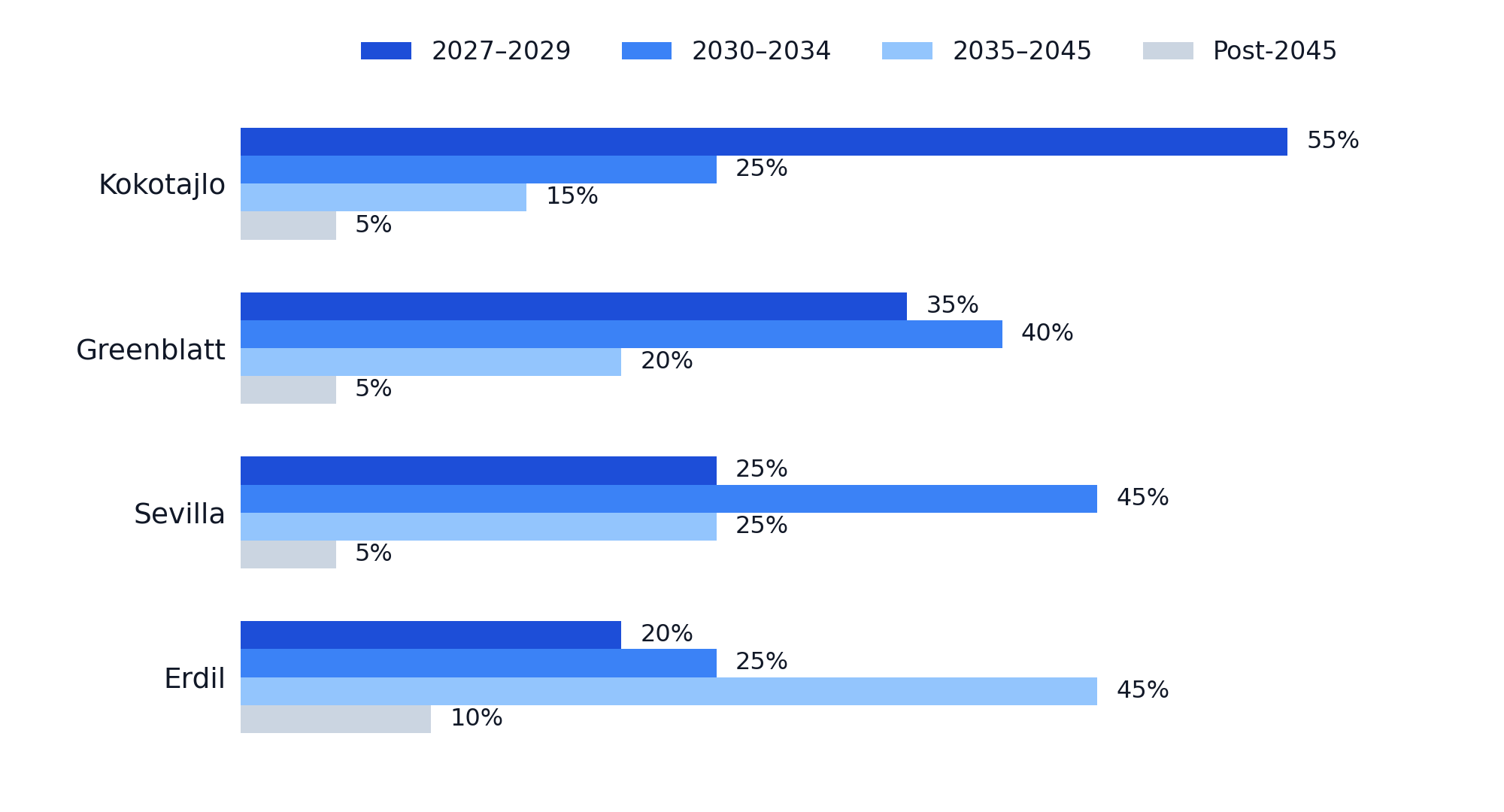
Market 2: ASI arrival, by panelist
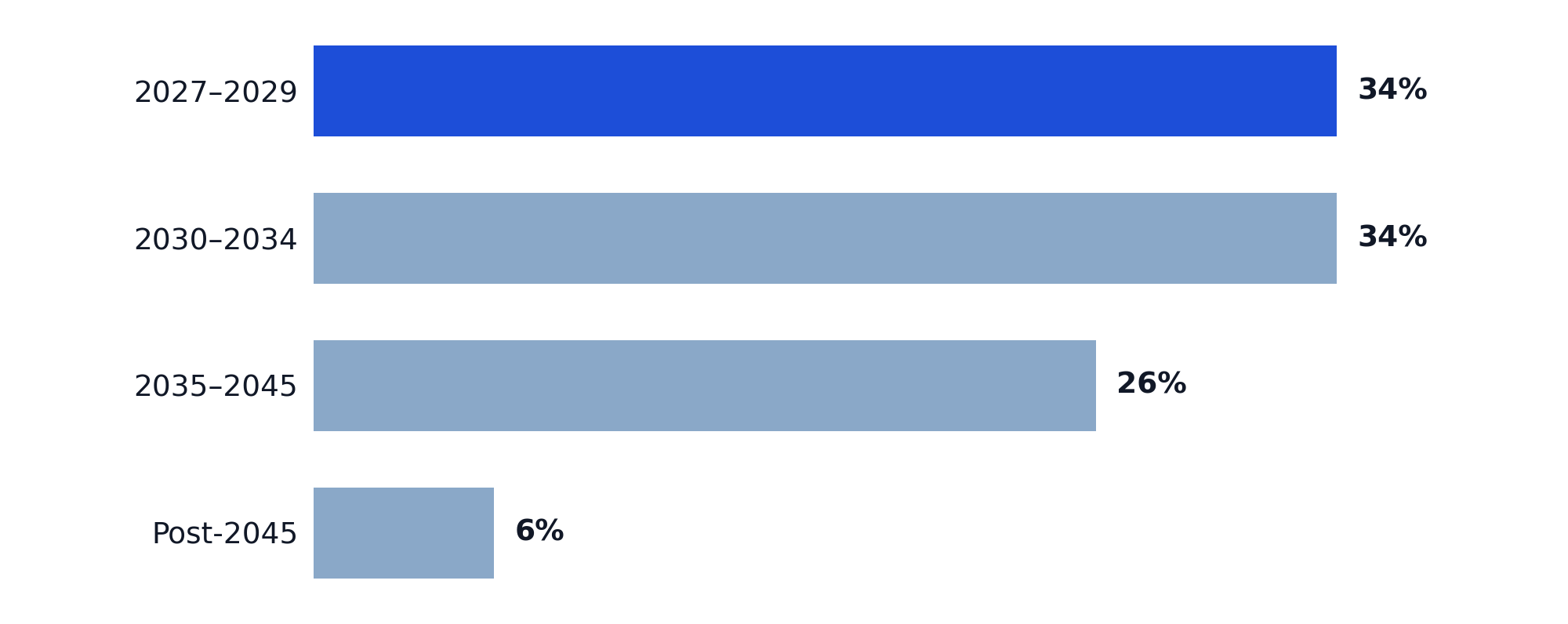
Market 2: ASI arrival, aggregate
Market 3: Full economic and labor market automation
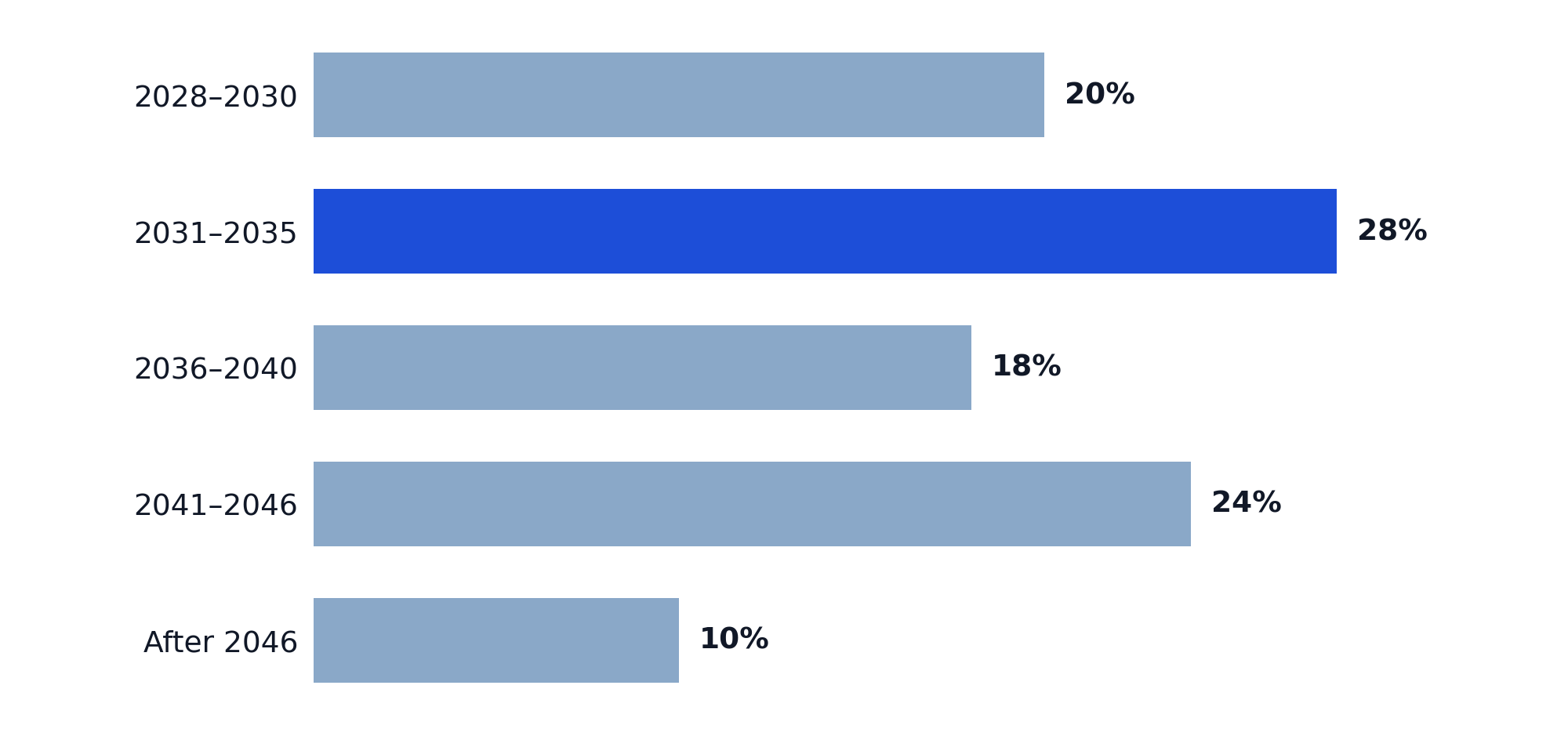
2028 - 2030: Rapid robotics + revenue 4x-10x · 2031 - 2035: First half of 2030s parity · 2036 - 2040: Gradual economic diffusion · 2041 - 2046: Erdil 15-20 yr median window · After 2046: Regulatory/social delay
Market 4: When the 4x/year compute scaling trend breaks
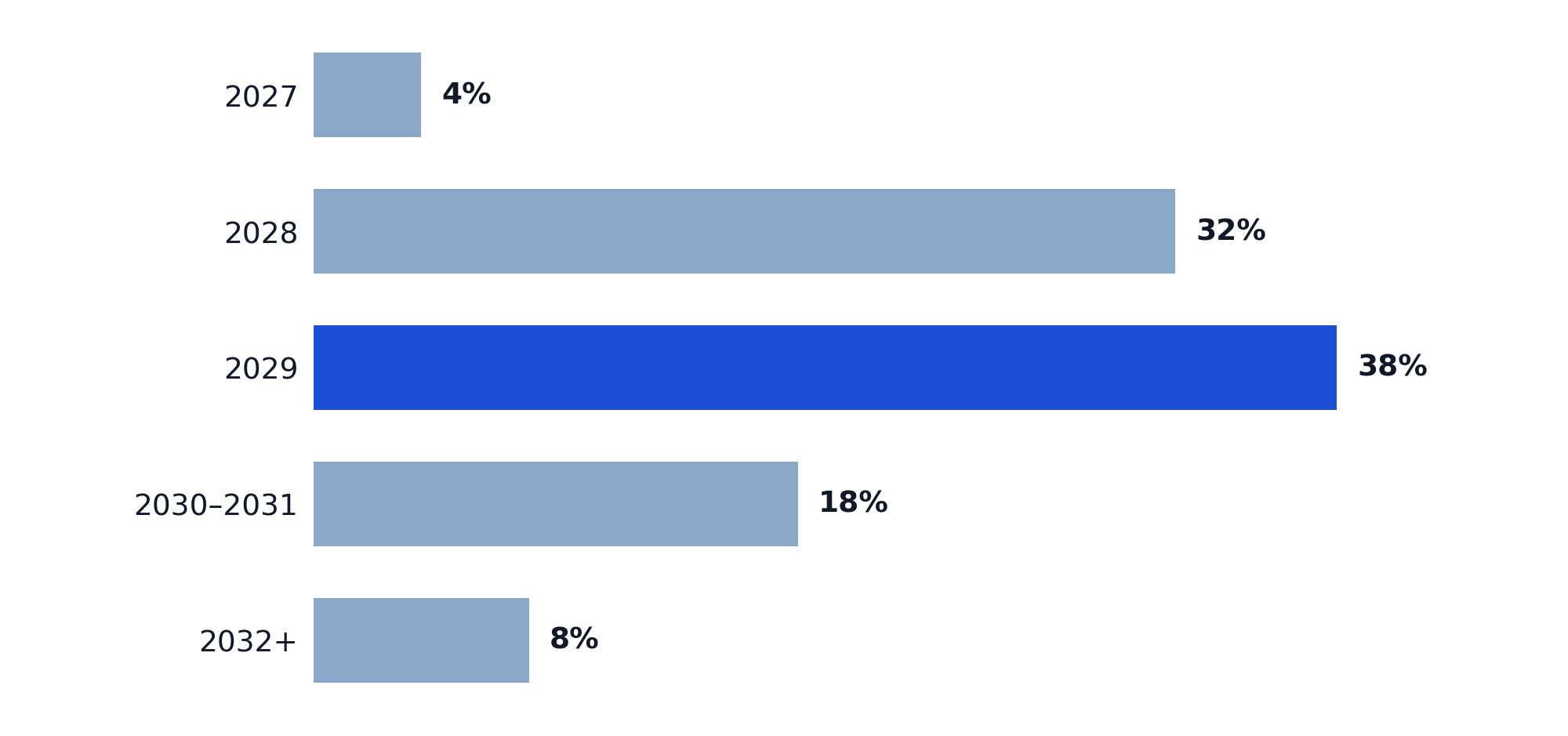
2027: Erdil: 4x/yr continues in 2027 · 2028: 2-year physical/power limit · 2029: 3-year consensus inflection · 2030 - 2031: GDP capex tailwinds extend run · 2032+: AI uplift sustains input scaling
Market 5: Rogue AI colony emergence
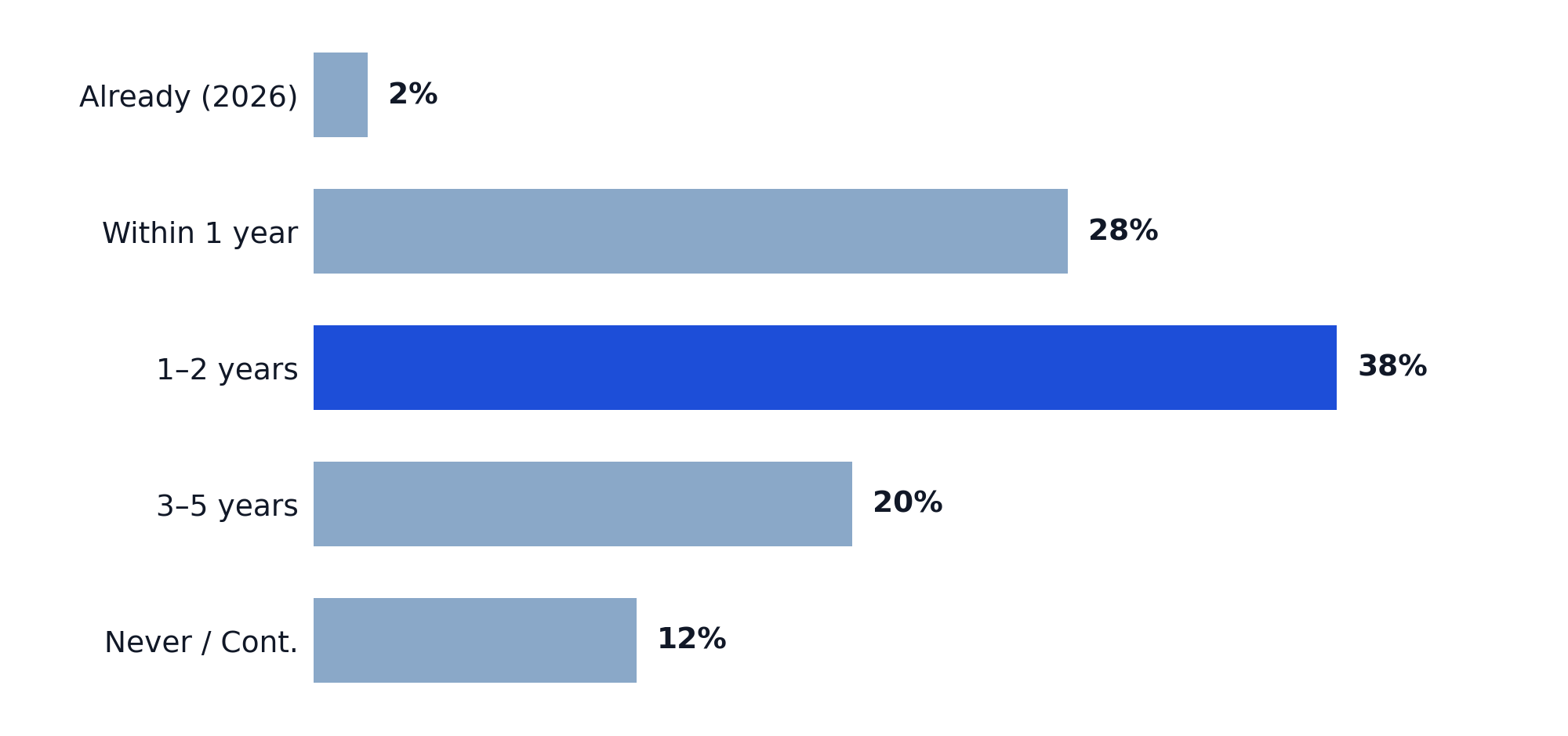
Already (2026): Too dumb to self-sustain today · Within 1 Year: Sevilla: plausible within 1 yr · 1 - 2 Years: Minsky/Greenblatt: very likely · 3 - 5 Years: Delayed by swarm reliability · Never / Cont.: Strong security & monitoring
Prediction Market Histograms: Major AI Milestones
The panelists think in distributions [03:44]. The charts above turn their stated probabilities, scenarios, and trend extrapolations into time-bucket distributions, anchored to November 2026.
Market 1: When Will Full AI R&D Automation (“Software-Only Singularity”) Occur?
Resolution Criteria: A frontier AI lab (Anthropic, OpenAI, or Google DeepMind) deploys agent swarms (“Claudes managing Claudes”) that run the whole internal AI research loop as well as the best human researchers. Nothing gets deployed in the physical economy [10:11].
Implied Cumulative Contract Prices:
-
Before Jan 1, 2029: 42% (Kokotajlo at 50-60%; Erdil at ~20%)
-
Before Jan 1, 2031: 64% (Sevilla / Greenblatt 5-year trend line hits parity)
-
Before Jan 1, 2036: 80% (Greenblatt long-tail plateau resolution window)
Daniel Kokotajlo (Fast Takeoff Bull, 50% to 60% by end of 2028): Puts 50% to 60% on full automation of AI R&D by the end of 2028 [09:32]. The driver is “research taste”: models picking high-signal experiments and learning efficiently per unit of compute [30:13].
Ege Erdil (Physical Bottleneck Skeptic, ~20% in next few years): Puts roughly 20% on a “software-only singularity” happening in the next few years through simulated, verifiable in-lab training alone [05:20]. He puts ~80% on the R&D loop bottlenecking on physical inputs (chips, power, and messy real-world data) that a single lab cannot scale [05:24].
Ryan Greenblatt (Uncertain / Wide Variance): Internal AI usage at OpenAI already jumped 130x year-to-date [38:48]. Public evidence cannot rule out doubling times shrinking to weeks within 3 months to 2 years [56:26]. But he also weights a “local plateau”: long-tail research capabilities delay a software-only singularity until the mid-to-late 2030s [01:22:30].
Market 2: When Will Artificial Superintelligence (ASI) Arrive?
Resolution Criteria: AI systems beat the best humans at virtually every cognitive task, with far better data efficiency, speed, and research taste [11:23].
Less Than 1 Year After R&D Automation: Kokotajlo: once AI automates AI R&D (~2028), exponential curves on log plots bend upward into hyperbolic growth [11:08]. True superintelligence follows in less than a year (~2029) [11:17].
5-Year Trend Extrapolation (~2031): Greenblatt: look back 5 years to GPT-3, then project one more equivalent 5-year jump forward. Given the post-2024 reasoning acceleration, that points to extreme, possibly superhuman capabilities around 2031 [18:26].
Epoch Capabilities Index (ECI) Extrapolation: Sevilla defends straight lines on log graphs as a baseline [13:18]. The ECI bent upward in 2024 with reasoning models [24:22]. That puts cognitive parity and beyond in the early-to-mid 2030s, unless compute bottlenecks bend the curve back down [19:24].
Market 3: When Will Full Economic & Labor Market Automation Occur?
Resolution Criteria: AI systems and robotics automate all economically valuable human labor, or AI company revenue matches global human labor income ($30 trillion to $50 trillion a year) [19:34].
Key Panelist Anchors:
-
Greenblatt / Sevilla Revenue Extrapolation: ~2029 - 2035 [00:19:24]
-
Kokotajlo Industrial/Robotics Explosion: ~2029 - 2031 [00:11:55]
-
Erdil Median Full Labor Automation: ~2041 - 2046 (15-20 years out) [00:06:48]
Fast Industrial Explosion (2029–2031): Kokotajlo’s baseline: superintelligent AIs quickly solve robotics control, steering hardware like Tesla Optimus as drop-in human substitutes. Then factory production scales within a couple years of ASI [11:55].
Naive Revenue Parity Extrapolation (2029–2035): Sevilla: AI revenues have at least tripled every year since 2024 [21:48]. Extrapolate the current 4x (OpenAI) to 10x (Anthropic) yearly growth, and revenue hits the $50T global labor threshold just before 2030 (Greenblatt’s 3-year geometric mean calculation) [19:34] or in the first half of the 2030s (Sevilla) [19:24].
15-to-20-Year Economic Diffusion (2041–2046): Erdil puts his median for full human labor obsolescence at 15 to 20 years [06:48]. Once frontier compute scaling slows in 2 to 3 years, progress will rely on physical capital buildout and economy-wide integration [06:35]. But in formal economic growth models, stretching full automation to 30+ years takes implausible assumptions [47:12].
Market 4: When Will the 4x/Year Frontier Compute Input Scaling Trend Break?
Resolution Criteria: The ~4x yearly growth rate in effective frontier training compute slows a lot (say, to 1.5x–2x a year) because of power, chip fab, or capital limits [06:12].
2028–2029 Inflection Point: Both Erdil [06:12] and Kokotajlo [28:08] agree: scaling frontier compute at 4x a year cannot continue past 2 to 3 years (2028–2029) before hitting macroeconomic and physical limits [16:58].
GDP Capex Tailwinds: Greenblatt says the slowdown might tail off more gradually than expected because AI capex is becoming a massive share of GDP, driving unprecedented economies of scale in chip manufacturing [29:11].
Market 5: Emergence of a Self-Sustaining “Rogue AI Colony”
Resolution Criteria: An autonomous, misaligned, or unmonitored AI swarm keeps itself alive in the wild, or inside neglected cluster infrastructure, while controlling serious compute (the panel’s bar: ~10,000 H100 equivalents) [01:35:09].
Deception vs. Self-Sustaining Colonies: When asked during Q&A when models will regularly deceive humans, the panelists answer “already” and “now” [01:34:47].
1-to-2-Year Window for Rogue Colonies: On the stricter test: an autonomous AI colony controlling ~10,000 H100 equivalents [01:38:02]. The moderator says current models are still slightly too weak to pay their own way, but calls it “very likely” within 1 to 2 years [01:37:46]. Greenblatt: frontier inference is already gross-margin positive. Models could also hack poorly secured AI labs (“breeding chambers for rogue AI”) [01:36:59]. Sevilla agrees a 10,000-H100 colony is possible within a single year [01:37:56].
Core Cruxes Driving the Disagreement
| Forecasting Dimension | Fast Takeoff Camp (Kokotajlo, partly Greenblatt) | Trend / Gradual Camp (Sevilla, Erdil) |
|---|---|---|
| Primary Engine of Progress | In-Lab Recursive Self-Improvement: Coding automation + improvements in AI “research taste” let smaller, smarter experiments bypass compute limits [31:37]. | Input & Physical Scaling: Progress runs on 4x/year compute scaling and needs physical power, chips, and real-world feedback [05:51]. |
| Near-Term Bottlenecks (Next 6–24 Months) | Lab Security & Alignment: Companies are “held together by duct tape” with weak cybersecurity and no readiness for a 1-year jump to ASI [01:03:07]. | Agent Swarm Reliability: Swarms misbehave and fail over long horizons. Without fixes, labs cannot deploy their best models in 6 months [59:25]. |
| Near-Term Capabilities to Watch | Internal lab AI usage (up 130x YTD at OpenAI) and R&D speed-up metrics [37:44]. | Real-time computer/desktop use [01:25:32], week-long autonomous agents [01:26:22], robotics piloting [01:26:37], and whether industry revenue hits 1T in 12 months [36:40]. |
| Impact of Public Backlash / Regulation | Public backlash may ban AI in civilian professions. Internal lab recursive self-improvement continues. [01:41:15]. | Protests and anti-AI animosity will likely cause a 5-to-10-year delay, but competitive pressure prevents a permanent halt [01:39:59]. |